Faudzil @ Ajak

Faudzil @ Ajak
Always think how to do things differently. - Faudzil Harun@Ajak
Showing posts with label WORLD POLITICAL SCANDALS. Show all posts

12 December 2013

POLITICAL SCANDALS - Singapore's political scandals put ours in perspective


Singapore's political scandals put ours in perspective

Bernard Chan compares our illegal structures with sex and corruption


PUBLISHED : Friday, 28 December, 2012, 12:00am
UPDATED : Friday, 28 December, 2012, 1:36am

Singapore's parliamentary speaker Michael Palmer (left) announced his resignation after confessing he had an extramarital affair with a community worker. Photo: AFP

Singapore, like Hong Kong, prides itself on clean government. Yet, like Hong Kong, the Lion City has been hit by a wave of scandals involving officials and other supposedly respectable members of the establishment.
In Hong Kong, the uproar has been about unauthorised building works on people's homes. Over the last year or two, two chief executives and a surprising number of senior officials have been accused of having such works on their properties. Hong Kong people like real estate, and the gossip magazines have been full of details about unauthorised additions in buildings and gardens.
In Singapore, the big scandals have been about sex, and as with the exposés about unauthorised building works here, it is hard to keep up with them all.
Two senior officials in government departments have been accused of accepting sex for contracts. A law professor allegedly accepted sex for grades from a student (not to mention several other shocking incidents in the education sector). Some 50 men, many public servants or businessmen, allegedly used an underage prostitute. The speaker of parliament, a senior member of the ruling party, recently resigned after admitting he had an affair with a community worker.
One difference between the two cities is that in Hong Kong, we have a vibrant and outspoken free press. Some media outlets thrive on gossip and rumour, to the extent that scandals here can become a form of entertainment. Most of us, including thick-skinned officials, have enough of a sense of humour to know when the press is exaggerating. That should help keep issues in perspective.
In Singapore, things are more controlled, and officials are not used to allegations and insults. They certainly do not see the funny side of them.
Having said that, the cities' respective scandals are worlds apart. Some of the allegations in Singapore amount to corruption - an extremely serious offence in both cities. The underage prostitute story could also involve criminal offences. These, too, would be no laughing matter in Hong Kong.
Maybe we should learn something from what both cities are going through. Singapore's spate of sex scandals has raised some big questions. Is the country undergoing some sort of moral decline in its top levels of leadership? Has the strict and controlled nature of the political system and media played a part in insulating the establishment from scrutiny? Does the country need a more open system at this stage of its development? These are hefty issues for Singapore.
Should the unauthorised building works prompt that level of outrage and soul-searching in Hong Kong? Some people clearly seem to think so. Or at least they think they can score political points by appearing angry. But let's put things in perspective.
In Singapore, the building and construction authority's information booklet says no planning approval or authorisation is needed for lean-to extensions, sheds, trellises, partition walls, awnings, cantilevered roofs, single-storey huts, glass enclosures of terraces, boundary walls and gates and a lot of other items that we in Hong Kong see as illegal structures. It seems this is one area where Singapore is free and Hong Kong is authoritarian.
If it seems that a lot of politicians in Hong Kong have unauthorised building works, it is because a lot of property owners do - including my own family, who are currently getting several problems rectified. Of an estimated 800,000 such works in 2000, the Buildings Department says more than half have been removed, but there must be many that are unknown, or still being built. Many owners do not even know they have them.
It is not hard to accuse a lot of property owners of having an illegal structure - then of negligence, and then of covering something up. You just need to look hard enough.
In Singapore, a government official was found to have accepted sex from a manager in a private-sector supplier in exchange for commercial advantages. There is uproar. In Hong Kong, a government official is found to have a laundry rack on his wall. There is also uproar. But ask any Singaporean: there is no comparison.
Bernard Chan is a member of the Executive Council
This article appeared in the South China Morning Post print edition as Singapore's political scandals put HK's own in perspective.

Source: http://www.scmp.com

POLITICAL SCANDALS - Cheeky game puts politics in the hands of Malaysians


Cheeky game puts politics in the hands of Malaysians

By Peter Shadbolt, CNN
May 6, 2013 -- Updated 0047 GMT (0847 HKT)
Players of Politiko are asked to out-scheme their opponents in a game that mirrors Malaysian politics
STORY HIGHLIGHTS
  • Tongue-in-cheek card game is based on Malaysian dirty politics
  • Players must out-scheme each other to be voted into parliament
  • Contestants are asked to buy votes, hire phantom voters and control the media
  • In an ironic twist, the game has become popular with some Malaysian politicians
(CNN) -- Politics might well be a dirty game, but in Malaysia where allegations of vote-buying, sex scandals and violence are a feature of the political landscape, a group of disaffected activists have distilled these predictable shabby tricks into a popular card game.
Called Politiko, players are asked to woo voters with cash handouts, use elements of Sharia law to lay low rivals, or pour petrol subsidies on troubled electoral waters.
"Hire phantom voters. Control the media. Cook up a sex scandal to alienate your enemy's supporters - or to betray your own allies!" says the game's website.
"Choose from 10 distinct (and familiar) political parties to lead to victory. Play with up to six friends, of any race. But are they really your friends? Remember: it's not about the people -- it's about Putrajaya," it adds, referring to Malaysia's administrative capital.
Politics looking forward in Malaysia
The tongue-in-cheek game is loosely based on Monopoly Deal but instead of dealing in property, players compete to get voters - the first to hold eight voter cards gets elected to parliament.
Before that can happen, players must negotiate the pitfalls of the "scheme" cards - either rising on the pork-barrel politics of free highway tolls and urban metro projects, or falling on crumbling allegiances and misplaced racial scapegoating.
Typically, the richest person at the card table gets to deal the first card.
In an ironic twist, the game has even become popular with some politicians in Malaysia's ruling UMNO coalition, according to the group that developed the card game.
The brainchild of 31-year-old designer Mun Kao - part of a group called Loyar Burok, which is affiliated with the Malaysian Center for Constitutionalism and Human Rights (MCCHR) - the game has quickly sold out of its initial run of 850 decks.
"I had the idea about two years ago when there really was a political circus going on - we had some ridiculous things happening in Malaysia," Mun Kao told CNN. "You had people being arrested for the color of their T-shirts and things like that and to me that period was really absurd.
"It prompted a lot of emotions in a lot of people and it's being expressed in different forms. If you have Malaysian friends you can see it on Facebook and online - I think there's a creative expression tsunami going on," he said.
Malaysian media reports say about 2.6 million of the country's 13.3 million eligible voters will cast their ballots for the first time in a bitterly fought poll that could see the ruling Barisan Nasional (BN) coalition - which has been in power for 56 years - lose to opposition parties for the first time.
The number of new voters, many of them without party loyalties, has increased markedly since elections five years ago when there were 638,000 new voters. Analysts say that many young voters may have been encouraged to register by the closeness of the 2008 poll which the ruling coalition only narrowly won.
"We don't have a reliable mainstream media in Malaysia," said Chi Too, a communications officer with MCCHR. "The government owns pretty much all newspapers, all radio stations and TV stations. A lot of people are now relying on social media and alternative media that can be found with online newspapers and the like."
I had the idea about two years ago when there really was a political circus going on
Mun Kao
Websites such as Malaysiakini have become popular with young voters, streaming news and views generally unobtainable in Malaysia's mainstream press. Even so, it claims that it has been the victim of censorship tactics that have involved denial of service cyber-attacks on its streaming videos.
The Malaysian Communications and Multimedia Commission investigating the attacks said there were no such restrictions, adding that the public should not speculate until a proper investigation has been carried out.
The power of the online campaign has not been lost on the ruling coalition which this year launched the UMNO New Media Unit; a team of 2,000 of what it calls "cyber-activists" tasked with logging opposition attacks.
On Sunday, voters will be asked to choose between the Barisan Nasional (BN) coalition, which -- with its predecessor -- has ruled the country for more than five decades, and Pakatan Rakyat (PR), a loose coalition of opposition parties formed after the last election in 2008.
BN is led by Prime Minister Najib Razak, the son and nephew of former prime ministers, who has held the post since 2009.
PR is headed by Anwar Ibrahim, a former finance and deputy prime minister who served time in prison on corruption and sodomy charges which he says were politically motivated. The first sodomy charge was overturned in 2004 and in January 2012 he was acquitted of a second charge of sodomy, a serious offense in Malaysia which carries a sentence of up to 20 years in prison.
In a hard-fought campaign, both parties have been trying to entice voters with promises of generous government spending.

POLITICAL SCANDALS - Top 8 Political Scandals in France


Top 8 Political Scandals in France

The internet is abuzz with gossip about French President Nicolas Sarkozy and his singer-model wife Carla Bruni. An incident in case being the President’s alleged drunken speech at the G8 summit.
But over the years, various French politicians have been involved in much more serious scandals that have been widely reported in the French and international media. Between the 80’s and 90’s, abuse of public money and election rigging topped the list of scandals. Here’s a list of the top political scandals that challenged the French people’s trust in France’s political system.

1. The Generals’ Affair – 1949 -1950
The Generals’ Affair was a political-military scandal that took place during the First Indo-China War that lasted from September 1949 to November 1950. French General George Revers was sent to Indo-China to study the situation and prepare a military and political report. His recommendations revealed a very pessimistic picture of the French position on Indo-China, which was contrary to Paris’s official optimism. The real scandal exploded when the secret report fell into the hands of Vietminh who broadcasted parts of the report, humiliating the French.

On further enquiry, it was found that Revers was not an expert on military issues but only a reserve army officer with an impressive track record. The report had been leaked by a second man, an alleged spy and Revers’ friend Roger Pyre. It eventually fell into Vietminh’s hands where sections of it were revealed. The report was also aired in France by their first news magazine, L’Express.

2. Ben Barka Affair – 1965
Mehdi Ben Barka, Moroccan politician and head of left-wing National Union of Popular Forces, went missing on October 29, 1965. He had been exiled from Morocco after openly supporting Algeria. It was alleged that he had been kidnapped by French police officers, who were helped by Moroccan agents. The involvement of the French Intelligence was subsequently proved. After the disappearance was publicized widely by the media, President De Gaulle made a formal statement that his government was not involved.
After trials in 1967, two French police officers were sent to prison for their part in the kidnapping. While judges deemed Moroccan Minister Mohamed Oufkir, the mastermind behind Ben Barka’s abduction and murder guilty, French Prefect of Police Maurice Papon was also forced to resign after the incident.
3. Sinking of the Rainbow Warrior – 1985
In the 1980s, Greenpeace tried to thwart France’s efforts of developing and testing nuclear warheads. Greenpeace had decided to lead yachts to the French Polynesian atoll, the site of the testing, in protest. When they learned of this protest, the French Intelligence Services tried to sink the flagship of the Greenpeace fleet in the port of Auckland, New Zealand. But photographs of the scene led to the arrest of two French agents by the New Zealand police. It was a known fact that New Zealand was opposed to the development of nuclear weapons and on the other hand, it was an ally of France.
What made matters worse was that France initially denied the accusations. However, later in 2005, Admiral Pierre Lacoste, Head of Direction Générale de la Sécurité Extérieure confessed that the attack was authorized by the then French President François Mitterrand.
4. Infected Blood Scandal – 1991
In a tragic incident, between 1984 and 1985, hemophiliac patients in France contracted AIDS after being treated with non heat-treated blood products. The infected blood scandal became public after a journalist and doctor Anne Casteret wrote for a weekly magazine about how the Centre National de Transfusion Sanguine distributed the blood products knowing that they were not heat treated correctly.
After subsequent investigations, in 1999, former Prime Minister Laurent Fabius, Health Minister Edmond Herve and Social Affairs Minister Georgina Dufoix and were arrested on charges of manslaughter.
5. City of Paris Gardening Services Scandal – 2004
In 2004, Mayor of Paris Bertrand Delanoe alleged that the members of the political party Rally for the Republic (RPR) had used the City of Paris gardening services for private purposes free of cost. More than €700,000 of public funds was spent in beautifying gardens of party members in upscale Parisian suburbs. They even enjoyed free gardening services from City of Paris employees. City supplies were also used for private gardening use.
6. Voting Scandal in the 5th Arrondissement – 2005
In this controversy, a French Mayor devised an innovative method of rigging the local elections. The 5th arrondissement/administrative district voting scandal involved Mayor Jean Tiberi and his wife Xavière Tiberi. On their instructions, 7,228 people were illegally registered in the 5th arrondissement in 1997 out of which 3,315 cast their votes when Jean Tiberi was elected Deputy with a lead of 2,725 votes.
A criminal investigation was launched against Tiberi in 2005 for his role in the fraudulent voting incident.
7. The Clearstream Affair – 2007
This political scandal in 2007 revolved around the Luxembourg bank Clearstream Banking S.A., which allegedly helped many prominent French politicians and companies to evade taxes. A list of private accounts held by French individuals at Clearstream was sent anonymously to investigating magistrate Renaud van Ruymbeke on four different occasions. The lists were proved to be false and the people named on them, including French politician Nicolas Sarkozy, who was then preparing for his Presidential campaign, pressed charges for false accusations.
It was later revealed that Dominique de Villepinhad, Interior Minister and Sarkozy’s rival, was aware of the lists being forged but had not passed on the information to Judge van Ruymbeke. He was subsequently tried at the Paris Correctional Court in September and October 2009.
8. Angolagate – 1990s
Perhaps one of the biggest political scandals ever to occur in France, Angolagate involved arms-oil exchange deals between Pierre Falcone, the Head of Brenco International, a colleague called Jean Christophe Mitterand, and Arkadi Gaydamak, an Israeli born in Russia.
Gaydamak channeled billions in arms and oil collateral loans to Angola’s government and got high value oil contracts with oil companies from West in return. Gaydamak and Falcone were successful in transferring 463 million dollars as arms to Angola, thanks to the connections that Mitterand had with the Angolan government.
Mitterand was given a two-year suspended sentence and fined €375,000 in 2009.
After ex-President Jacques Chirac’s indictment, many more political-financial scandals involving the government have come to the forefront. Current President Nicolas Sarkozy, in his election campaign had vowed to fight corruption in the government and execute stringent action against those involved in political scandals.
It has been three years since he was elected but how exactly he plans on fulfilling his electoral promise is yet to become clear. Do you think the current French government has any real intent of fighting corruption, or will it remain just another unfulfilled electoral promise?
- See more at: http://www.pfhub.com/political-scandals-in-france/#sthash.I0nyBGVI.dpuf

POLITICAL SCANDALS - Top 7 Political Scandals in Greece


Top 7 Political Scandals in Greece

Between 2006 and 2009, a number of scandals involving Greek politicians made it to the news. Formal enquiries were launched and the cases were tried in court. But in most cases, stringent action was not taken and some of the accused simply walked free. Here’s the list of top scandals that disgraced the Greece’s government and politics in recent times.

1. Bonds Controversy – March 2007
In this scandal, unstructured bonds were sold in Feb 2007 to state pension funds. They had been underwritten by JP Morgan for the government and later sold to North Asset Management at 92.95% of their nominal value. These bonds were eventually bought by state pension funds at very high prices in the secondary market.
The government-brokered arrangement came under criticism from the public as well as the opposition. In June, North Asset Management and J P Morgan under pressure and criticism agreed to buy the complete bonds issue to cover up the losses pension funds had made. Labour Minister Savvas Tsitouridis was sacked after the incident and charges of money laundering were framed against him.
2. Vassilis Magginas Controversy – December 2007
In this scandal, Labour Minister Vassilis Magginas was accused of harboring uninsured foreign workers in his Athens home. Allegations that the minister had allowed free accommodation to an Indian uninsured couple and their three children surfaced in 2007. This led to his resignation. But subsequent enquiries into the issue did not yield any conclusive results and the minister was cleared of charges after getting full support from the government.
3. Ferry Contracts Controversy – April 2009
Party Deputy Aristotle Pavlides was embroiled in a bribery scandal in 2009 after it was alleged that his aide had demanded bribes from a private ship-owning firm to grant a contract to ferry routes on the Aegean island. The Minister maintained throughout that he was innocent and refused to resign from his position. Investigations were launched after the case was moved to the Parliament but the Minister escaped indictment.
4. Phone Tapping Controversy – 2004-2005
In March 2006, the government revealed that phones of more than 100 eminent Greek personalities, including that of Prime Minister Costas Karamanlis had been tapped between 2004 and 2005. After a two year investigation failed to yield results, the case was dropped and government concluded that foreign intelligence agencies were responsible. The Greek government was criticized for its mishandling of the case and failure to determine the mastermind behind the illegal tapping.
Vodafone Greece was fined €76 million by Greece’s Communication Privacy Protection Authority and charged with breach of privacy.
5. Sex Tape Scandal – February 2008
In February 2008, a sex scandal involving former Culture Ministry General Secretary Christos Zahopoulos surfaced. DVDs of the minister having sex with his female assistant was produced in the office of Prime Minister Costas Karamanlis. It was referred to as the ‘sex lied and dvd’ scandal by the media.
After news of the incident became public, Zahopoulus stepped down from his post and jumped from his fifth-floor balcony. He survived the fall but the sex scandal caused a lot of embarrassment to the Greek government.
6. Vatopedi Controversy – September 2008
Merchant Marine Minister George Voulgarakis and deputy ministers were accused in land swap deals, involving the wealthy Vatopedi monastery. It was alleged that the accused had spent over 100 million Euros in taxpayer money to finance the land deals. The investigations revealed a land swap between Voulgarakis and the Vatopedi monastery, which also involved the Minister’s wife who acted as an agent in the transaction.
An investigating committee was set up by the Parliament in October. Minister of State Theodore Roussopoulos resigned after news of his suspected involvement in the case surfaced. But the investigations failed to gather enough evidence and were halted in December.
7.7. Siemens Controversy – May 2008
In 2008, allegations of bribery against Siemens surfaced after it was found that the company had paid substantial sums to government officials and other companies to win deals, including security contracts for the 2004 Athens Olympics and a contract for the Athens subway. Close to 100 million Euros in bribe money was involved in the case.
The allegations have not been proved against Siemens or the Greek government. Siemens has also been charged with other corrupt dealings involving the Greek government, including spending millions to fund political campaigns of favored candidates.
After the debt crisis, citizens are demanding that Prime Minister George Papandreou makes good on his promise to stamp out corruption in the government. With so many political and corruption scandals disgracing the government in the past few years and little action being taken against those involved, the growing public resentment towards the government is only just. It is high time that Prime Minister Papandreou stepped up to tackle issues of corruption and transparency in his government.
Will the Greeks finally hold their ground and come out of the mess? It just remains to be seen.
- See more at: http://www.pfhub.com/top-7-political-scandals-in-greece/#sthash.0BwVmlzP.dpuf

POLITICAL SCANDALS - Top 9 Political Scandals in the United Kingdom


Top 9 Political Scandals in the United Kingdom

Most governing and opposition parties in the UK have had their share of political scandals through the years. The British media has had a field day with political scandals on various occasions. The lurid details of financial and sex scandals have been splashed across the British tabloids, resulting in many high profile personalities resigning and tendering public apologies. Here are a few such scandals:

No. 1: Fake Suicide Scandal – 1974
This 1974 scandal involving British politician John Stonehouse had the makings of a mystery-novel plot. Stonehouse had a distinguished political career, being MP of Stonewall and Secretary to Minister of Aviation. In 1969, allegations that Stonehouse was a Czech agent first surfaced. Though the accusations were never confirmed, he found himself sidelined after the Labour Party lost the 1970s election.
Stonehouse then decided to become an entrepreneur. His business ventures were a failure and he started indulging in fraud. After he became aware that the Department of Trade and Industry was keeping a close watch on him, he hatched a plot. He managed to make two fake passports and fled to Australia. But not before faking his suicide by leaving his clothes on a Miami beach and disappearing all of a sudden. This did not last long- he was discovered in Melbourne and consequently sentenced by the British judiciary to seven years in prison.
No. 2: Lavender List Scandal – 1976
The Prime Minister’s Resignation Honors List to mark Prime Minister Harold Wilson’s resignation was referred to as the ‘Lavender List’ after the issue erupted into a controversy. The strange list consisted mostly of wealthy businessmen who were at that time opposed to the ruling party’s policies. Ironically, two businessmen on the list were convicted of fraud in the late 1970s. The media criticized Wilson’s decision to give knighthoods and peerages to such businessmen, calling his list ‘eccentric’. The name ‘Lavender List’ was coined after it became known that the original draft of the list was written on lavender-colored notepaper.

No. 3: Sale of Arms to Iraq – 1990

After the 1991 Gulf war, it was alleged that the UK government had sold arms to Iraq, under the rule of Saddam Hussain. The government had advised Matrix Churchill, a company that manufactured tools to produce weapons, on exporting the tools to Iraq and how to go about the dealing without attracting public attention. After the incident was exposed, Prime Minster John Mayor’s approval rating dipped further and contributed to the landslide win for Tony Blair’s Labour party in the ’97 elections.
No. 4: Tobacco Advertising Scandal – 1997
The Labour Party had promised to ban tobacco advertising in its election manifesto during the 1997 general elections. During the time, all major Formula 1 teams were sponsored by leading tobacco brands such as Rothmans and Marlboro. F1 owner Bernie Ecclestone appealed to Tony Blair’s chief of staff for an exemption, claiming that loss of tobacco money would cause redundancies and losses. F1 was subsequently exempted from the tobacco sponsorship decision. The media criticized this decision and further inquiry revealed that Ecclestone had donated £1 million to the Labour party. Tony Blair later publicly apologized for not handling the issue properly and said that the money would be returned.
No. 5: Tessa Jowell Financial Scandal – 2006
Tessa Jowell, UK Secretary of State for Culture, Media and Sport in the Labour Party, was accused of corruption. The scandal revolved around her lawyer husband’s false evidence in Italian prime Minister Silvio Berlusconi’s court case, for which he was paid £340,000 pounds. Jowell then converted the money into a hedge fund. She claimed that she had no involvement in the scandal and made a statement that she would separate from her husband.
No. 6: Ron Davies ‘Moment of Madness’ Scandal – 1998
In a humiliating incident, Welsh Secretary of State and Member of Parliament Ron Davies resigned after being embroiled in a gay sex scandal. In 1998, he was spotted chatting with a man in Clapham Common, a well-known gay meeting place and was later mugged in the same area at knife point. When this news made it to the papers, he admitted to being bisexual and suffering from a personality disorder. Davies, on the instructions of Tony Blair’s press secretary to play down the incident, told the media that he had done it in a ‘moment of madness’.
No. 7: Cash for Honours – 2006-2007
The ‘Cash for Honours’ scandal made the news in the UK in 2006 and 2007. It revolved around the link between political donations and award of life peerages.
In March 2006, many men who were recommended for life peerages by Prime Minister Tony Blair were rejected by the House of Lords Appointments Commission. It was discovered that the men had loaned substantial sums of money to the Labour Party, in a deal proposed by Labour fundraiser Lord Levy. The selling of honours case was handed over to the Metropolitan Police. During the investigation many members of the Labour Party, including Tony Blair were called for questioning by the police. The scandal brought disgrace to the Labour party and they were ordered to repay the loans.
No. 8: Parliamentary Expenses Scandal – 2009
This major political scandal revolved around the expenses claimed by Members of Parliament over many years. The British Public was shocked and angered after The Telegraph published details of MP’s expenses. The list revealed the misuse of taxpayer money by MPs and after the incident came to light, they promised to repay the money. The scandal resulted in a number of resignations, sackings and public apologies.
No. 9: Profumo Scandal – 1963
The Profumo Affair of 1963 is one Britain’s most shocking sex scandals involving John Profumo, Secretary of State for War. Profumo, a married man, got involved with call girl Christine Keeler in 1960. The relationship did not last long. But news of the affair became public in 1962 and to add to his woes, it was alleged that Keeler was also in a relationship with Yevgeny Ivanov, a senior Soviet Russian officer.
The political ramifications of such an affair during the time of Cold War were serious and Profumo had to make a statement on the issue. He however denied the allegation in the House of Commons in March 1963. Shortly thereafter, he confessed to lying about the affair and stepped down from his cabinet post. During the scandal, provocative pictures of Christine Keeler found their way into British tabloids. The scandal almost brought the government down and references to the Profumo affair have been made in many songs and movies.
Many of the UK’s politicians have misused their powers and brought shame upon themselves by getting involved in shady financial deals and sexual exploits. One of the world’s oldest constitutional monarchies and successful economies has been in the news for all the wrong reasons because of political scandals. While most British politicians have ended up admitting their mistakes and apologizing to the public, there would be many cases that have simply gone undetected.
Uk Scandals
If you can think of any important details that I missed or other important UK scandals that I missed feel free to let me know.
- See more at: http://www.pfhub.com/top-9-political-scandals-in-the-united-kingdom/#sthash.6kHQ5pS0.dpuf

POLITICAL SCANDALS - Top 7 Political Scandals in Japan


Top 7 Political Scandals in Japan

Most of Japan’s political scandals have revolved around bribes and misappropriation of funds by top Japanese officials. Powerful private sector firms have been found to be in cahoots with government officials in carrying out these large scale corrupt activities. There is a systematic misuse of funds to meet the needs of influential businessmen and the political elite. Here are the most infamous political scandals that have rocked the Japanese government and politics over the years.

1. Oura Scandal – 1915
This scandal of the early twentieth century took place during the late Meiji and Taisho period of Japanese politics. During World War I, the administration of Prime Minister Okuma Shigenobu requested for funds for military expenditure from the lower house of the Diet of Japan and the requests were passed by the house. But when the request for additional funds to support another 86,000 men in the Imperial Japanese army was made, it was turned down by the lower house.
The majority of the lower house was then controlled by opposition political parties hostile to Shigenobu, who decide to vote against the request. On March 25th, 1915, Shigenobu dissolved the house and called for fresh elections.
Okuma won by a landslide margin and was able to get the bill passed on military spending. But a couple of months after the election, allegations against Home Minister Oura Kanetaka began to surface. It was alleged that he had given funds from the Rikken Doshikai party to Hayashida Kametaro, the Chief Secretary of the lower house, for distribution among undecided members to vote in favor of Okuma’s military spending bill. Kametaro resigned and was subsequently arrested. Oura was also forced to resign, but was not prosecuted.
2. Siemens Scandal – 1914
Another political scandal of late Meiji and Taisho period of Japanese politics involved several high ranking members of the Imperial Japanese Navy, the British company Vickers and the German industrial conglomerate of Siemens AG.

The Japanese navy was importing advanced weaponry from Europe and most naval contracts were signed with Siemens after a 15% bribe was given to the Japanese naval authorities. In 1914, British company Vickers offered a 25% bribe to authorities with an extra 40,000 Yen offered to Vice Admiral Matsumoto Yawara. When Siemens learnt out about the deal, they demanded a clarification. During this time, an employee of the Siemens Tokyo office stole documents providing proof of Siemens’s backdoor tactics to the Reuters news agency.

The scandal became public and investigations were launched into the scandal. A Japanese newspaper reported that the navy procurement office had received payments from Vickers amounting to a total of 210,000 yen. Violent, large-scale protests erupted in Tokyo. The public was further incensed when it was revealed that the large scale investments in the naval expansion program would have left room for little else in the government budget and the government were planning to raise taxes to make up for the expenditure.
3. Teijin Scandal – 1934
The Teijin scandal resulted in the fall of Prime Minister Saito Makoto’s administration. In June 1933, a body of young businessmen, the Banchokai bought 100,000 shares of the textile firm Teijin from the Bank of Taiwan at 125 yen per share. By the end of the year, the stock had gone up to 200 yuan. There were rumors that the Banchokai had somehow managed to manipulate the stock market.
The Ministry of Justice subsequently accused officials in the Ministry of Finance and Prime Minister Saito’s cabinet members of conspiring with the Bank of Taiwan to allow the Banchokai to buy the shares at low prices in return for cash and stock bribes. In 1934, the Minister of Finance, the Director of the Bank of Taiwan and the President of Teijin were arrested. Following this, Prime Minister Saito had to dissolve the government on 3 July 1934.
4. Democratic Party Funding Scandal – 2010
Ichiro Ozawa, kingpin of the ruling Democratic Party has recently been embroiled in a funding scandal alleging that he took bribes from construction firms to invest in property.
Known as the “Shadow Shogun” in Japan, he claims that he is innocent. In question is a $4 million plot of land bought in 2004 by Mr Ozawa’s political fundraising organization. Prosecutors are still investigating how the party sourced such a large sum of money. Reports suggest involvement of construction firms seeking public contracts. The scandal is likely to have major implications on the political future of Japan’s Prime Minister Yukio Hatoyama, who has resigned recently.
5. Agriculture Minister Financial Scandal – 2007
Japan’s agriculture minister Toshikatsu Matsuoka committed suicide after being embroiled in a political scandal where he was charged with manipulating the utility costs of his parliamentary office. He took to the drastic measure after being subject to questioning in the parliament.
In 2007, it was alleged that Matsuoka had claimed $236,600 in utility costs even though his rented parliamentary office offered utilities free of cost. He was also accused of not declaring $8,500 in political donations.
6. Japanese HIV Tainted Blood Scandal – 1980s
In this shocking incident, close to two thousand haemophilia patients in Japan contracted HIV after using non-heat treated blood products. The Health Ministry was criticized for not introducing heat-treated blood products that prevented spread of infection. After the incident, high-ranking officials in the Ministry of Health and Welfare were charged with involuntary manslaughter.
In 1989, the HIV-infected hemophiliacs in Osaka and Tokyo filed lawsuits against the Ministry and five Japanese drug companies. The head of the Health Ministry’s AIDS research team, Dr. Abe Takeshi was also tried but found not guilty in 2005.
7. Recruit Scandal – 1988
This is a corruption scandal in the 80’s involving Recruit, a Tokyo-based human resources company and many high-profile Japanese politicians. Chairman of Recruit Hiromasa Ezoe offered senior politicians a number of shares in its subsidiary, Cosmos, shortly before Cosmos went public in 1986. Following the initial public offering, Cosmos’s share price shot up and those involved made profits up to 66 million yen each.
Among the politicians involved in the scandal were Prime Minister Noboru Takeshita, former Prime Minister Yasuhiro Nakasone and Chief Cabinet Secretary Takao Fujinami. Members of Takeshita’s cabinet were forced to resign after the incident became public.
Political scandals in Japan time and again have revolved around fraud, money laundering and election funding. Prime Minister Yukio Hatoyama’s approval ratings dipped after he had to face humiliation in a political funding scandal. It is high time that Japan’s politicians focus their energies on solving the country’s debt woes instead of indulging in corruption for personal gain – do you think the future Japanese politicians will come clean and honest?

Source: http://www.pfhub.com

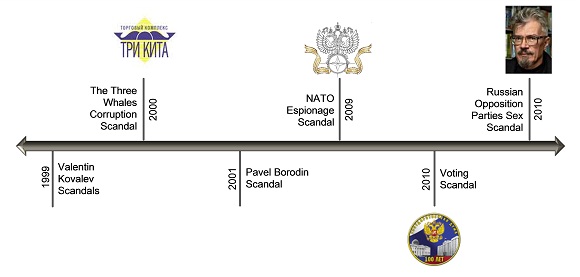
POLITICAL SCANDALS - Top 6 Political Scandals in Russia


Top 6 Political Scandals in Russia

Russia once enjoyed superpower status but the current economic scenario is in stark contrast to its achievements in the Soviet era. But an even bigger problem is the extent of corruption and scandals in Russian politics.
They have not only created a bad reputation of the country’s political system, but have also led to many problems for the Russian people. Here are a few such scandals that have tainted Russian politics.
1. Voting Scandal – 2010
A video showing Russian deputies running from seat to seat pressing voting buttons for colleagues who were absent that day has been doing the rounds recently. This is the latest political scandal disgracing the State Duma, which is Russia’s lower house of Parliament. A drunk-driving law being debated in the State Duma was passed by almost 440 deputies even though just 88 members were present on that day.
2. Russian Opposition Parties Sex Scandal – 2010
In a bizarre chain of incidents, a woman who goes by the name Katya, seduced a number of politicians from Russia’s opposition parties on different occasions. The videos of the sexual escapades were uploaded on different sites and disgraced the opposition.
Those involved include the founder of the banned National Bolshevik Party Eduard Limonov, Alexander Belov, former leader of the nationalist Movement Against Illegal Immigration and upcoming young politician Ilya Yashin. They have accused the current government for using the seductress as bait to embarrass them in the public eye. The scandal has been termed as ‘Katyagate’ by the Russian media.
3. Valentin Kovalev Scandals – 1999
Former Russian Minister of Justice Valentin Kovalev was arrested in February 1999 after being charged with embezzling $50,000 from state funds and illegal possession of firearms. In 1997, he had been forced to resign after steamy videos of Kovalev and some women in a sauna were published on a Russian website.
The grainy video was filmed through a keyhole at a nightclub belonging to criminal gang Solntsevo. Rumors of Kovalev having links to criminal organizations were also validated after the video was leaked.
While it caused a sensation in the tabloids, what was more surprising was how the government had done nothing to cover up the scandal or prevent it from reaching the media. Russian ministers have a tight security cover at all times and private revelations are usually nipped in the bud by the government. It was later alleged that this was the government’s way of making him relinquish his post.
4. Pavel Borodin Scandal – 2001
Pavel Borodin, State Secretary of Russia and Belarus Union, was arrested in 2001 on allegations of bribery and money laundering. He allegedly received bribes of upto $25 million from Swiss companies Mabatex and Mercata for contracts to renovate Kremlin.
Borodin was later released on a bond of five million Swiss francs paid by the Russian government. He was not even questioned by the Geneva Court- the bail fees handed out by Russia had guaranteed his freedom. The case against him was closed in 2002.
5. The Three Whales Corruption Scandal – 2000
The Three Whales Corruption Scandal involved furniture companies and government officials of the Russian Federation. A 2000 investigation revealed that the owner of furniture shopping complex Three Wales (Tri kita), Sergei Zuev, had not paid custom duty amounting to $5 million and provided inaccurate information on imported goods. The suppliers Bastion and Liga Mars were accused of smuggling 400 tons of furniture into Moscow.
A probe by investigator Captain Pavel Zaitsev was halted by the then Prosecutor-General Vladimir Ustinov. The reason was that the shop was controlled by former FSB (Federal Security Service of the Russian Federation).
The accused companies had paid officials from the Prosecutor General Office upto $2 million dollars to hush up the case. Witnesses were threatened with death and some were also attacked to prevent them from testifying. After subsequent investigations, Ustinov and all other officials who had tried to cover up the case were suspended.
6. NATO Espionage Scandal – 2009
Two Russian diplomats were kicked out of NATO after accusations of espionage relating to secret NATO documents. It started in February, when Estonian defence chief Herman Simm was found guilty of selling thousands of highly classified Nato documents to Russian intelligence officials. This transfer of information had been going on for 12 years before he was finally caught.
The espionage by Russian intelligence had seriously compromised the security of fellow NATO countries. In an ironic and embarrassing coincidence, the Russian officials were booted out on the same day that Nato took up talks again with Moscow following an 8-year suspension on account of Russia’s war with Georgia.
The Russian media today enjoys more freedom of expression than during the Soviet era. But with an authoritative government, politicians seldom care if scandals make public news. In fact, some have been known to capitalize on the publicity to further their careers. Most scandals go unpunished, with the Russian government protecting the accused officials, especially those who are deemed important.
Source: http://www.pfhub.com


POLITICAL SCANDALS - Top 6 Political Scandals in China


Top 6 Political Scandals in China

China is an emerging superpower with a literacy rate of 90.9% and multi trillion dollar economy. Though its communist government is power yielding, it has encouraged privatization that has contributed to the country’s rapid growth. With its defiance of western political ideologies, strict regulations and restriction of free speech, China’s strict policies are feared and respected in equal measure.
But everything is not as perfect as it looks the Chinese government has seen its share of political scandals that have discredited those in power time and again. We discuss a few such scandals here that directly or indirectly involved the Chinese government.

1. Chu Mei-feng Sex Scandal – 2001
In Dec 2001, a sex video of Chu Mei-feng, a Taiwanese politician was released by Scoop, a Taiwan based tabloid. Chu Mei-feng was a Taipei city council-woman during the time. The video that was circulated widely on the internet caused a lot of embarrassment to Mei-feng and the Taipei City Government. Investigations into the scandal revealed that Kuo Yu-ling, a friend of Chu had installed a hidden camera in her bedroom and sold the video to Scoop. Kuo was later charged with invasion of privacy, stealing and hurting public morality.
2. Shanghai Pension Fund Scandal – 2006
The Communist party Head of Shanghai, Chen Liangyu and many other officials were dismissed after misusing pension funds amounting to almost 10 billion yuans and diverting them into real estate and private railroad investments. Liangyu was sentenced to 18 years rigorous imprisonment on charges of fraud, bribery and stock manipulation. This scandal exposed that the extent of corruption among political parties permeates right from grass-root level to the very top of China’s political system.
3. Chinese Tainted Milk Scandal – 2008
After milk tainted with melamine caused hospitalization of hundreds of babies in China, the government accepted that it was partly responsible for negligence in supervising the accused dairy companies. The quality of Chinese exports have been attacked all across the world, but this particular case involving the health of babies came under severe criticism by international audiences and the Chinese public alike. The parents of hospitalized children sued the involved companies, prompting the government to send inspectors to the dairy companies’ factories for 24-hour supervision. Government officials were also fired for their failure to monitor these companies.
The scandal exposed the lack of standardized testing procedure that should have been introduced by the Chinese government from the collection of raw milk to the manufacturing of dairy products at factories. Premier Wen Jiabao admitted to a major Chinese newspaper that the government was partly to blame for this unfortunate incident.
4. Chen Shui-bian Money Laundering Scandal – 2008
Chen Shui-bian, former President of the Republic of China is currently serving life imprisonment at the Taipei Detention Center. Fondly known as “Son of Taiwan”, the 58-year old and his family were charged with money laundering, embezzlement and misappropriation of government funds in 2008.
The first family was awarded sentences by the Taipei District Court. Shui-bian and his wife were sentenced to life and fined $15.3 million. His son was sentenced to two-and-a-half years and his daughter-in-law for one year and eight months. The charges brought against him included wiring up to $20 million into different international bank accounts created under fake names. He has undergone hunger strikes in prison and maintains that he is innocent although he has made public apologies accepting his part in misappropriation of campaign funds.
5. Child Trafficking Scandal – 2007
Allegations of child trafficking in China’s Shanxi and Henan’s provinces and the government’s failure to stop the inhuman treatment of children were condemned in China’s media.
In a major police operation, 591 slave laborers, including 51 children were rescued after the parents of the missing children launched a campaign urging government action. The world looked on in disbelief as TV footage and internet videos showed images of malnourished child laborers who had been sold to traffickers for 500 yuans each.
It became a full blown government scandal after online forums criticized the ruling communist government for not taking immediate action. Local party officials told parents that they should have taken better care of their children, a remark that was slammed by the media and public. Policemen and local politicians were accused of conspiring with the traffickers and President Hu Jintao’s government was accused of turning a blind eye to the issue.
6. Cyber Attacks Involving Chinese Government – 2009 & 2010
6.1 Cyber Attacks Against India
The Chinese intelligence agencies have been accused of cyber attacks on India to steal top-secret defense plans. An e-mail embedded with a Trojan virus compromised India’s military information in recent times. The compromised documents were related to the Iron Dome mobile missile defense system, Pechora anti-aircraft surface-to-air missile system, and Project Shakti, which is the advanced artillery combat and control system of the Indian Army. India’s intelligence agency RAW is looking into the matter and stepping up efforts to reinforce the country’s cyber defense system.

China was also accused of launching a cyber offensive against Dalai Lama’s office and the United Nations. A report, ‘Shadow in the Clouds’ said that the attacks were launched by cyber spies who had links to the Chinese underworld and information was passed to the Chinese government.
6.2 Cyber Attacks Against Google
A similar sophisticated cyber attack on Internet giant Google’s website drew a lot of suspicion towards the Chinese government who are opposed to free speech on the web and public forums. Attempts were made to access Gmail accounts of Chinese human rights activists.

In China, Google has been offering a censored version of its search engine in accordance with government regulations, but after the attack, Google has redirected Chinese users to its uncensored Hong Kong website.
After this attack, China has been publicly accused of corporate espionage. It is alleged that many US firms in the past have faced cyber attacks from China that are believed to be state-sponsored.
Political scandals come to light in all parts of the world – this only demonstrates that politics and corruption go hand in hand everywhere. It is just difficult to imagine a world with honest and ethical politicians. While the Chinese government has been embroiled in the usual sex and money laundering scandals, it is the recent cyber attack controversy that has the public wondering whether the emerging superpower will crush everything in its way to achieve its goals. Do you think this is truly the Chinese government’s intent?

Source: http://www.pfhub.com